

From 1 October 2026, Australian businesses will no longer be able to add card payment surcharges for relevant Visa, Mastercard, American Express and eftpos transactions — the ACCC explains the upcoming card surcharge changes.
For customers, the change should make paying by card simpler.
For business owners, the key question is how those payment costs will be reflected in their margins and pricing.
The surcharge may disappear from the customer's receipt. The underlying cost of accepting card payments still matters to the business.
At the same time, the reform will also reduce some interchange costs, particularly for smaller merchants.
That makes the Australian card surcharge ban a pricing and margin issue worth reviewing before October.
Card surcharge ban explained
Australia's card surcharge ban takes effect on 1 October 2026. Businesses will no longer be able to add card payment surcharges for relevant card transactions, so they will need to account for payment costs through their existing margins or pricing decisions.
What changes from 1 October 2026?
Businesses can currently charge a card surcharge, provided it does not exceed the business's cost of accepting that payment type. These rules remain in place until 30 September 2026.
From 1 October 2026, Visa, Mastercard, American Express and eftpos will introduce no-surcharge rules for relevant prepaid, debit and credit card payments. This means businesses will no longer be able to pass a card payment surcharge directly to customers.
At the same time, the Reserve Bank of Australia is changing its rules around interchange fees.
So two relevant changes are happening at the same time:
| Change | From 1 October 2026 |
|---|---|
| Card surcharge | No surcharge for relevant Visa, Mastercard, American Express and eftpos card payments |
| Consumer credit interchange cap | Maximum 0.30% |
| Commercial credit interchange cap | Maximum 0.80% |
| Debit and prepaid interchange cap | Maximum 8 cents or 0.16%, depending on the fee structure |
| Foreign-issued credit, debit and prepaid cards | 1.0% cap from 1 April 2027 |
These are wholesale interchange fee caps, so they do not represent the total fee a business pays its payment provider. The overall cost of accepting card payments can include interchange fees, scheme fees and the payment provider's own charges.
The surcharge disappears, but the payment cost remains
This is where the business decision becomes more interesting.
A card surcharge is the extra amount a business charges a customer for paying by card.
A card processing cost is what the business pays to accept and process that card payment.
They are related, but they are different things.
For example, suppose a business receives $100 from a customer.
If the business currently adds a 1.5% card surcharge, the customer pays $101.50.
From October, that additional $1.50 card surcharge will no longer be available for relevant transactions.
The business still has costs associated with accepting the payment.
Those costs can include fees within the card payment system, payment provider fees and other costs associated with processing the transaction.
One of those costs is the interchange fee.
In a typical card transaction, the merchant's payment provider pays an interchange fee to the customer's card-issuing bank. The payment provider then recovers interchange and other costs through the fees it charges the merchant.
The simplest way to picture the relationship is:
Customer pays by card
↓
Card payment system processes the transaction
↓
Business incurs payment costs
↓
Interchange is one component of those costs
The surcharge was one way businesses could recover some of those costs from the customer.
From October, businesses will need to account for those costs within their overall pricing and margins.
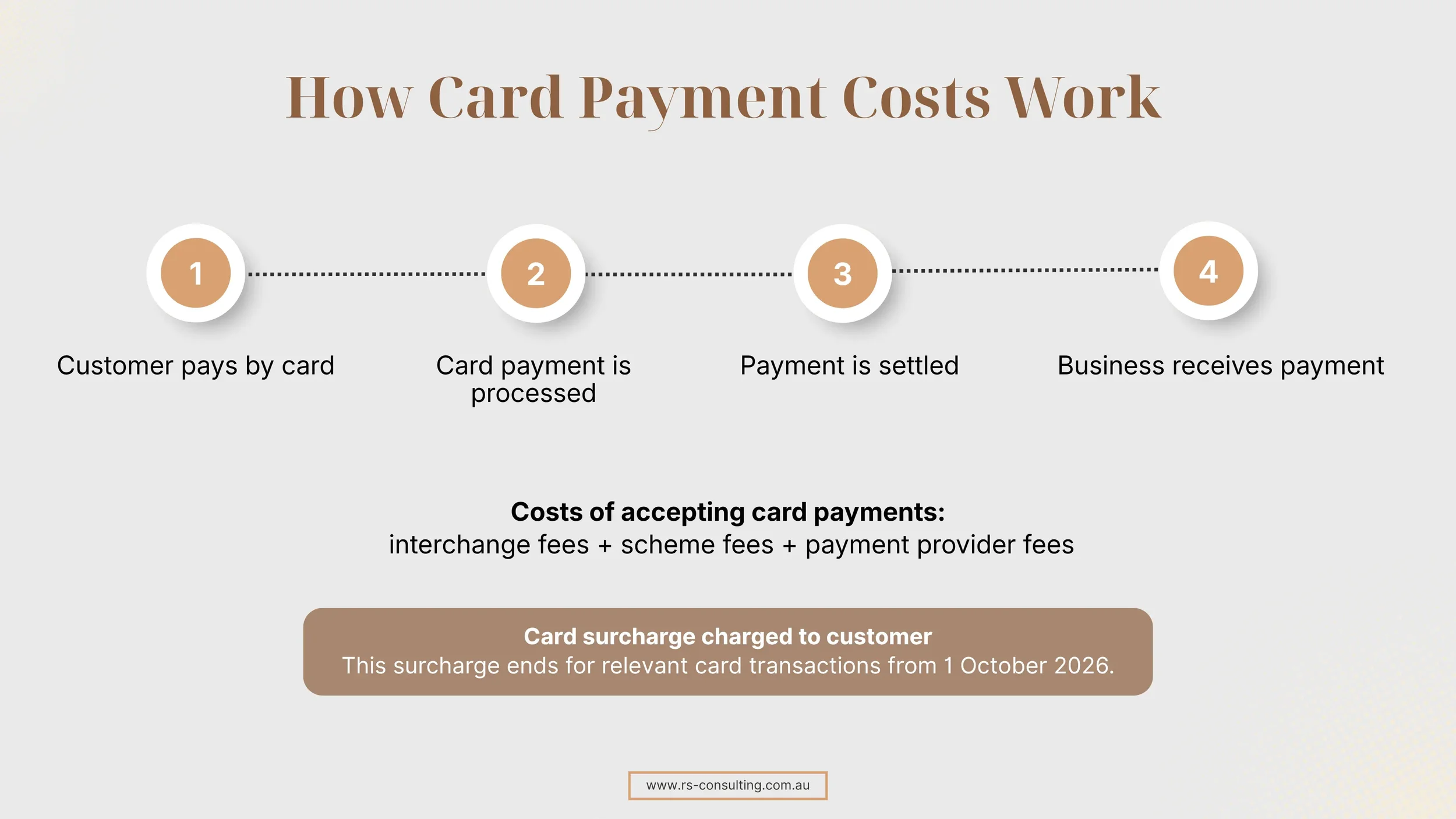
Understand how card payment processing costs work and what Australia's card surcharge ban means for businesses from 1 October 2026.
Your two pricing choices after the card surcharge ban
Once the surcharge disappears, a business generally has two immediate pricing choices.
1. Absorb the cost
The business keeps its advertised prices unchanged.
The payment cost then comes out of the existing margin.
This may be manageable for a business with strong margins and relatively low card payment costs. It can become more significant for a business with:
high card transaction volumes
low profit margins
high average payment costs
customers who predominantly pay by card
2. Adjust your prices
The business can incorporate its payment costs into its advertised prices.
Customers then see one price, regardless of whether they pay by card or another accepted method.
The Australian Competition and Consumer Commission has specifically noted that businesses are generally free to set, raise and lower their prices, provided they do not mislead consumers about pricing or the reasons for price increases.
For example, a business could review its existing prices and decide that an update is already appropriate because of several rising costs. The card payment change can form part of that broader pricing review.
The important number is your actual payment cost.
Look at your payment data before choosing a percentage increase. This gives you a clearer picture of how much the change could affect your margins and what pricing adjustment, if any, makes sense.
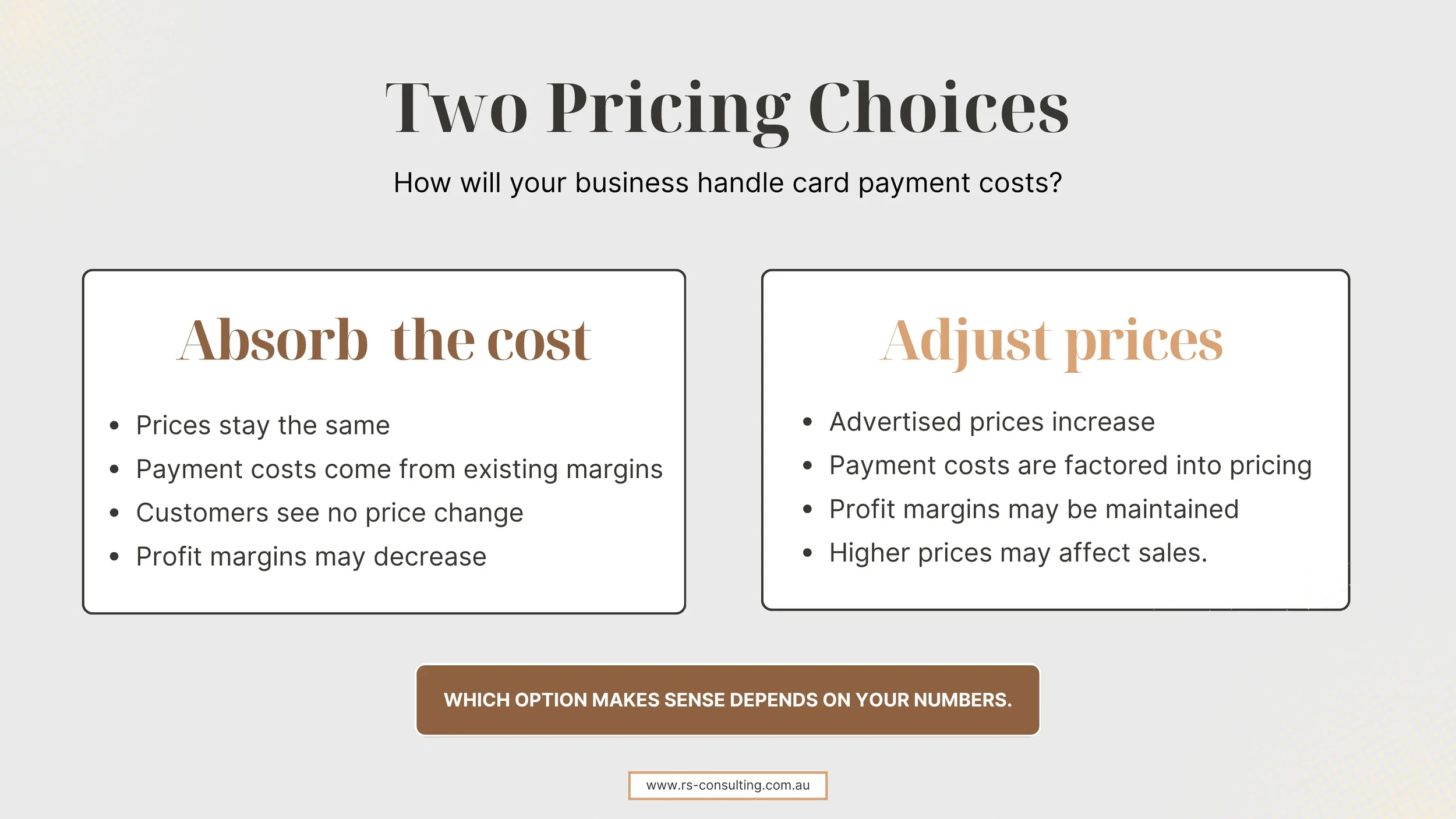
Businesses can absorb card payment costs or adjust prices following the card surcharge ban. The right approach depends on their costs, margins and customers.
A small payment cost can add up quickly
Percentages can look insignificant when you look at one transaction.
The annual number can tell a different story.
Imagine a business processes $300,000 in card payments each year.
If its average effective card payment cost is 1.5%, that represents approximately:
$300,000 × 1.5% = $4,500
That's $4,500 in annual payment costs.
For a business with healthy margins, absorbing that amount may be reasonable. For a business already operating on a tight margin, the same $4,500 could have a meaningful impact.
This is why I would look at the annual impact before deciding what to do.
Your payment provider's headline rate is also only part of the picture. Your actual payment costs can vary depending on the cards your customers use, your payment provider and the fees included in your payment arrangement.
That is why your own payment statements are more useful than relying on a standard percentage when reviewing the impact on your business.
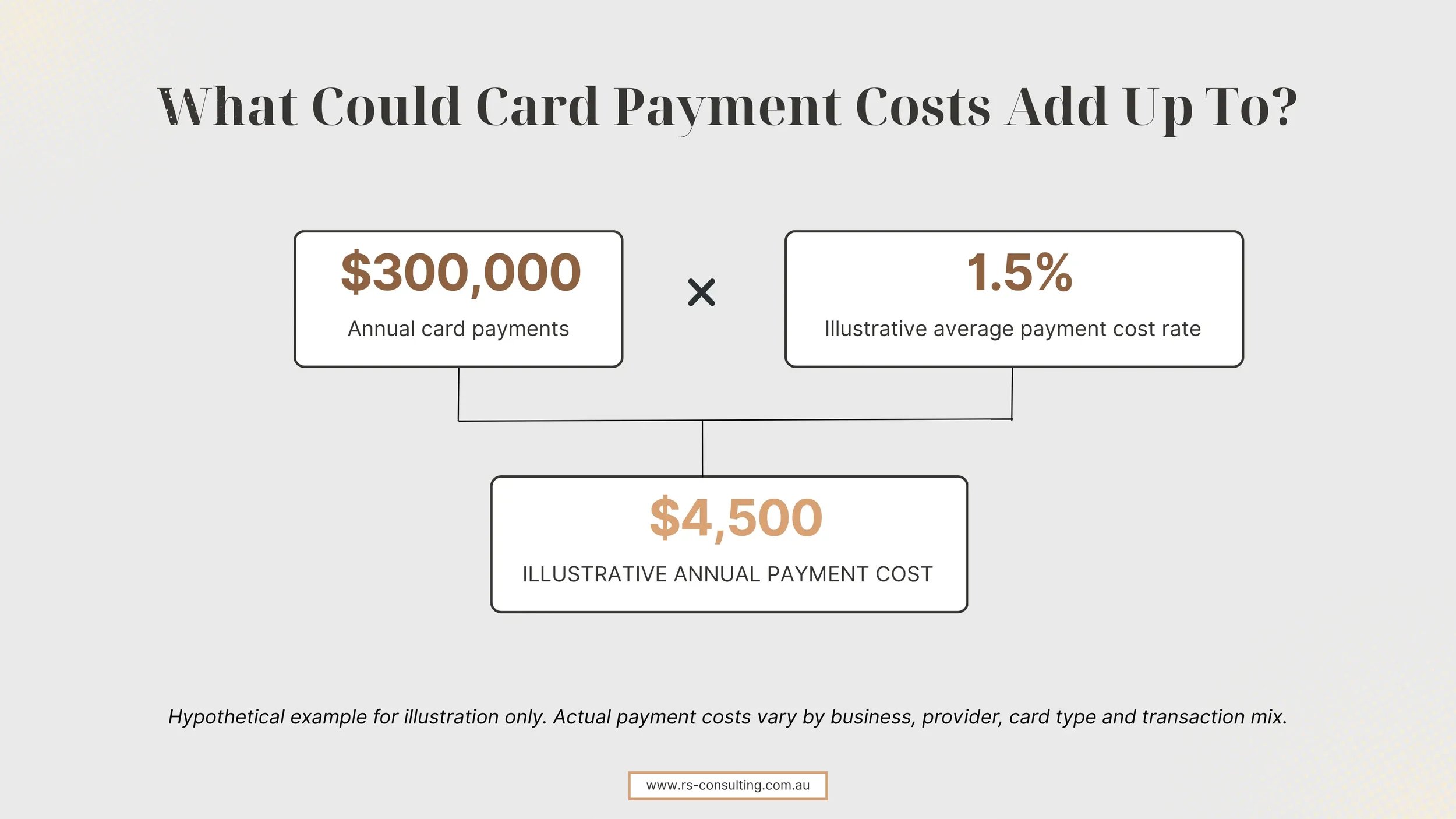
For illustration, $300,000 in annual card payments at an assumed 1.5% payment cost rate equals $4,500 a year. Actual costs vary by business and payment arrangements.
The interchange fee change could reduce some costs
There is another part of the reform that businesses should understand.
From 1 October 2026, the RBA will reduce the maximum interchange fee for domestic consumer credit card transactions from 0.80% to 0.30%. The cap for domestic commercial credit cards will remain at 0.80%. Debit and prepaid card interchange fees will also have lower caps, with a maximum of 8 cents per transaction or 0.16% of the transaction value.
The RBA expects these changes to reduce wholesale card payment costs for merchants by around $910 million per year, with small merchants expected to benefit significantly from lower interchange costs.
The RBA found that small merchants currently face interchange rates of up to 0.80% on consumer credit card transactions, while the largest merchants can receive strategic rates as low as 0.18%.
This helps explain why the interchange changes are expected to benefit smaller businesses. The new cap reduces the gap between the rates paid by smaller and larger merchants.
This matters because businesses currently approach card payments differently.
Some businesses already include their card payment costs in their prices and do not charge a separate surcharge. Others currently recover some of those costs by adding a surcharge to card payments.
In fact, the RBA says 85% of small merchants already do not surcharge, so the impact of the reform will vary depending on how a business currently handles card payments.
From October, businesses that currently surcharge will need to decide how to account for those costs within their overall pricing and margins. Businesses that already operate without a surcharge will not lose surcharge revenue. They may also benefit from lower interchange costs.
Your own payment statements will tell you how the changes are likely to affect your business.
What should you review before October?
You have time to understand the numbers before the rules change.
I would start with five things.
1. Check how much your business actually pays for card transactions
Look through your payment provider statements.
Calculate your actual annual cost where possible.
If your payment provider gives you a breakdown of debit, credit and prepaid card transactions, use that information when calculating your costs.
2. Check how much of your revenue comes through cards
A business that receives 20% of its revenue by card will have a different exposure from one that receives 90%.
The percentage matters.
The dollar amount matters more.
3. Check your margins
Look at your gross margin and overall profitability.
Then ask:
How much would absorbing payment costs reduce that margin?
You may find the effect is small.
You may also find that several small costs have been quietly accumulating.
4. Model your pricing options
Run the numbers for both scenarios:
Scenario A: Keep prices unchanged
How much additional annual cost would the business absorb?
Scenario B: Adjust prices
How much would prices need to change to maintain the desired margin?
You can then consider customer price sensitivity and the competitive position of your products or services.
5. Check every place where customers can pay
The change may affect more than your physical EFTPOS terminal.
Review:
EFTPOS terminals
online checkouts
payment gateways
invoices with card payment links
recurring payment systems
other customer-facing payment systems
The ACCC recommends that businesses speak with their payment service provider about disabling card surcharges and updating relevant payment systems.
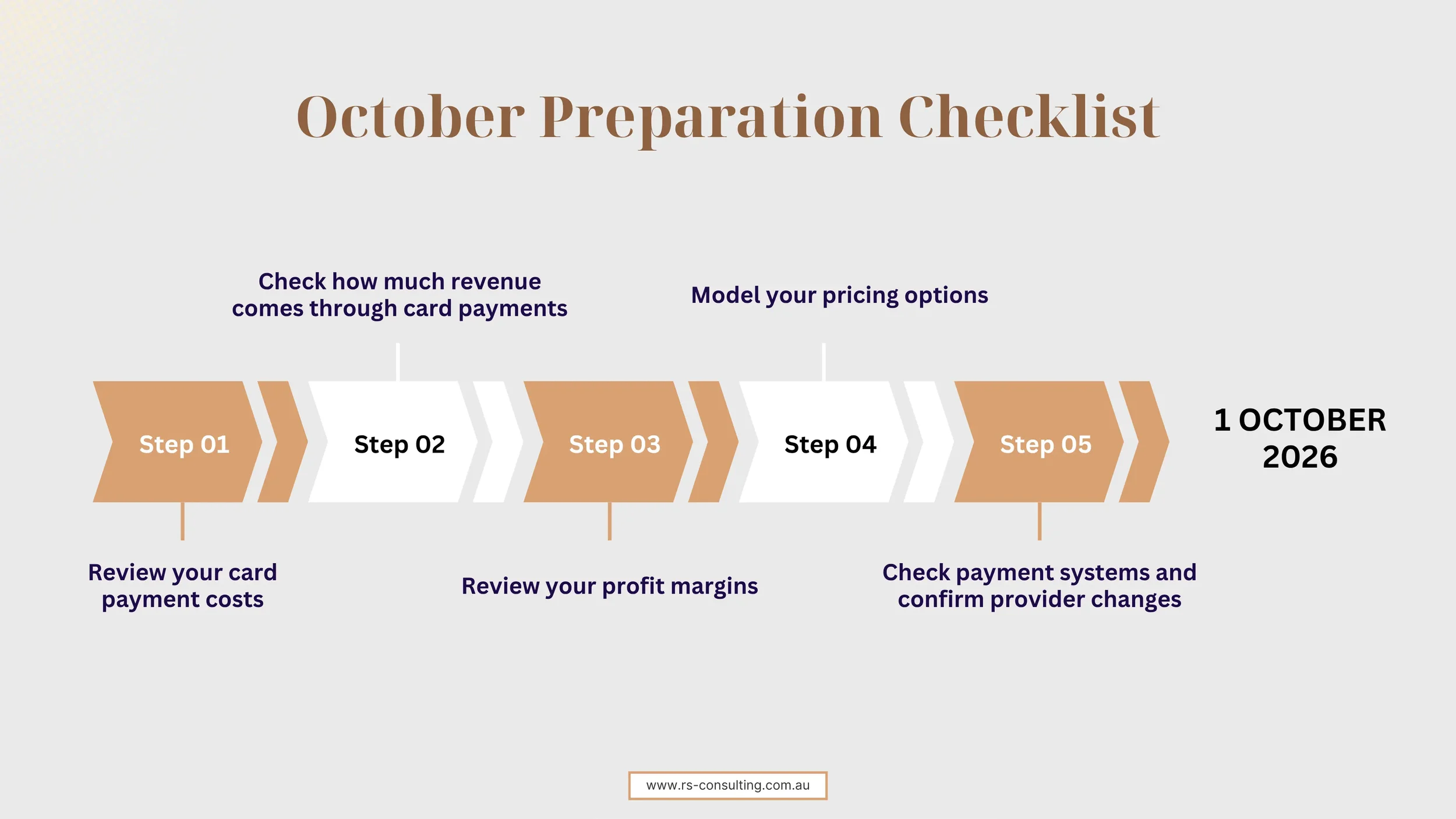
Prepare for the 1 October 2026 card surcharge ban by reviewing payment costs, revenue, margins, pricing options and payment provider changes.
A pricing review could reveal bigger margin problems
This is the part I find most useful about a change like this.
When you start looking closely at one cost, you can often see problems elsewhere.
You might discover that:
one service has a much lower margin than expected
some products take considerably more time to deliver
your prices have not kept pace with rising costs
one customer group has very different payment behaviour
certain services generate strong revenue but weak profit
payment costs are relatively small compared with another operational cost
The card surcharge ban can therefore become a useful trigger for a broader pricing review.
You might start by looking at a payment fee.
You could end up finding a pricing problem that has been sitting there for years.
That is where good financial information becomes useful.
Your accounts can tell you what happened.
Your margins can show you where the pressure sits.
Once you understand the numbers, you can decide whether to absorb the cost or adjust your prices.
The real question is what happens to your margin
The Australian card surcharge ban gives businesses a specific date to prepare for: 1 October 2026.
The practical decision comes down to your numbers.
You may choose to absorb the payment cost.
You may adjust your prices.
You may find that lower interchange costs offset part of the impact.
You may also discover that payment costs are only a small part of a larger pricing issue.
There is no single percentage increase that works for every business.
Your card transaction volume, payment costs, margins, customer behaviour and overall pricing model all matter.
That is why I would review the numbers before making the change.
A small payment cost can look insignificant on one transaction. Across thousands of transactions, it can become a meaningful part of your margin.
And that is exactly the kind of detail worth understanding before you make a pricing decision.
Quick summary
| What to know | Key point |
|---|---|
| Effective date | 1 October 2026 |
| Card surcharge | No longer permitted for relevant Visa, Mastercard, American Express and eftpos transactions |
| Consumer credit interchange cap | 0.30% from 1 October 2026 |
| Commercial credit interchange cap | 0.80% from 1 October 2026 |
| Debit and prepaid interchange cap | 8 cents per transaction or 0.16% of transaction value |
| Foreign-issued card cap | 1.0% from 1 April 2027 |
| Your pricing choices | Absorb the cost or adjust prices |
| What to do now | Review payment costs, margins and pricing before October |
If you would like to understand how the card surcharge ban could affect your pricing and margins, reach out to RS Consulting VIC for a practical review of your numbers and pricing strategy.
